The central geopolitical confrontation in the Americas is democracy versus crime
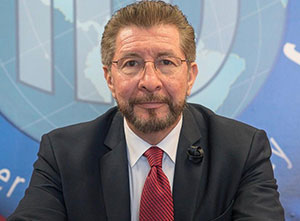
By: Carlos Sánchez Berzaín - 17/08/2026
Share:


The expansion of the Cuban dictatorship, using Venezuelan resources, as 21st-century socialism or Castro-Chavismo, resulted in transnational organized crime controlling governments and countries, supplanting politics with crime, and creating narco-states and para-dictatorial governments. The United States' national security policies altered geopolitics, and today the axis of confrontation in the Americas is democracy versus crime.
A narco-state is a country where “political institutions are influenced by the power and wealth of drug trafficking, whose government officials, protected by their authority and influence, are members of illegal drug trafficking networks, and whose security forces are ineffective in combating drug trafficking.” The Castro dictatorship established the first narco-state in the Americas in Cuba through the criminal activities of Fidel Castro with drug traffickers Pablo Escobar of Colombia and Roberto Suarez of Bolivia, activities that the execution of Castro's subordinates failed to conceal.
The expansion of the Cuban dictatorship in the 21st century transformed Venezuela, Nicaragua, Bolivia, and Ecuador under Correa into dictatorships/narco-states, bases for narco-terrorism. The proclamation of “drug trafficking as a weapon of anti-imperialist struggle” in the Castroist narrative of the 1960s and the Castro-Chavista narrative of the 21st century was a public admission that 21st-century socialism would move from receiving drug trafficking funding (narco-links) to directing crime through control of governments, countries, and territories.
The aggression of 21st-century socialism against the democracies of all the Americas took the form of “hybrid warfare,” adding to narcoterrorism forced migration, human trafficking, manipulation of common criminal groups, financing of candidates and electoral campaigns, transnational assassinations and attacks, extortion, and a long list of crimes committed from the power of the governments they control.
The changing reality in the Americas began with the administration of President Trump, who, after several actions, issued the “United States of America National Security Strategy” 2025, which, with respect to the Western Hemisphere, states: “The Trump Corollary to the Monroe Doctrine. After years of neglect, the United States will reaffirm and enforce the Monroe Doctrine to restore American preeminence in the Western Hemisphere and protect our homeland and our access to key geographies throughout the region. We will deny non-hemispheric competitors the ability to position forces or other threatening capabilities, or to possess or control strategically vital assets, in our Hemisphere.”
The geopolitical shift is expressed in the Strategy itself: “Our objectives for the Western Hemisphere can be summarized as Attracting partners (recruiting) and expanding our presence. We will attract established partners in the hemisphere to control migration, stop drug trafficking, and strengthen stability and security on land and sea. We will expand by cultivating and strengthening new alliances, while reinforcing our nation’s position as the hemisphere’s preferred economic and security partner.”
In its relationship with governments in the Hemisphere, the position is: “…to recruit regional leaders who can contribute to creating tolerable stability in the region, even beyond its borders. These nations would help us stop illegal and destabilizing migration, neutralize cartels, boost production in neighboring countries, and develop local private economies, among other things. We will reward and encourage governments, political parties, and movements in the region that are aligned with our principles and strategy.”
Thus we have Operation "Spear of the South," the capture of dictator Nicolás Maduro (now imprisoned), the elimination of the leader of the Aragua train gang, Operation "Shield of the Americas," multiple extraditions, and more. The dismantling of organized crime is underway with the increasingly active participation of governments in the region. The new paradigm indicates that if a government cannot or will not fight crime, the United States has the resolve, the military capabilities, and the technology to do so.
It is not about right or left, nor about progressives or conservatives; the dispute for governments and power in the countries of the Americas today centers on the confrontation between organized crime (which has taken, and holds, power and governments in many Latin American countries) and the recovery of democratic normality (with the restoration of the rule of law, citizen and legal security, property rights, and the validity of human rights).
The so-called 21st-century left in the Americas is a proven, recurring, and unpunished crime: narcoterrorism, state terrorism, human rights violations, corruption, subservience to extra-hemispheric dictatorships like China, Iran, and Russia, forced migration, human trafficking, and more. The ongoing geopolitical shift indicates that it is time to end the presence of criminals in politics and governments.
*Lawyer and Political Scientist. Director of the Interamerican Institute for Democracy
«The opinions published herein are the sole responsibility of its author».