Europe, hybrid warfare and its survival
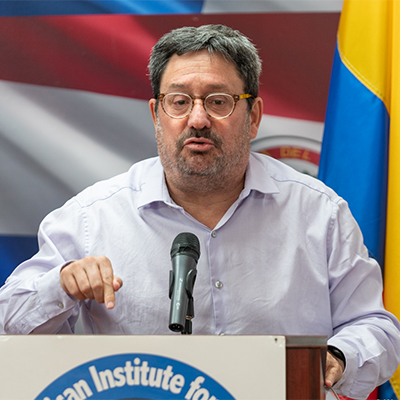
By: Francisco Santos - 28/10/2026
Share:


There are intellectuals who anticipate the future. One of them, Samuel Huntington, foresaw what is happening in Europe today and what the world is facing 35 years ago, when he wrote a study that later became a book entitled Clash of Civilizations.
What's incredible is that he did it without even considering the world of the internet, social media, or artificial intelligence in which we live today, and which makes it easier for those who want to destroy the West to unite, work together, and easily bring together such diverse issues as Palestine, environmental radicalism, the radical left, and Islamism into a single purpose.
We've already experienced this in Latin America; this hybrid warfare that, in Chile in 2019, set the capital ablaze and paved the way for the arrival of a communist president—albeit a democrat, which seems incompatible—Gabriel Boric. Two years later, in 2021, they did the same thing in Colombia. A few people, with the support of armed groups, seized roads, set fire to parts of cities, and, with the weakness of a government that failed to understand this hybrid warfare and confront it as it should have, created a scenario of chaos that opened the door to a populist president, Gustavo Petro.
The script is repeating itself. In Chile, the “trigger” was a rise in bus fares. In Colombia, it was the introduction of a tax reform. In France, one of the OECD countries that invests the most in education, it was a crisis in the education system. Obviously, this new hybrid war has a real component that those who want to destroy democracies—and even the West—are exploiting with great effectiveness, because they are partly right: the cost-of-living crisis and the unease among a young generation that has lived better than any generation before it in its history, but that sees no future.
In this hybrid war, in addition to that narrative that unfortunately no one counters, this destructive power uses criminality and the weakness of democracies to combat this supposed social protest, which is much more than that, to achieve its ultimate goal: to create chaos, to impose its own vision of the world and of the country, in which democracy and freedom have no place.
The chaos in France – which, without a doubt, will be repeated in England, Spain, Italy and Germany – opens the door to a response that we hope will come, because defending democracy and freedom today must become a priority for all countries facing this serious threat.
The radical and violent organizations that set the country ablaze have already been identified. The most serious aspect of the situation in France is that many of them are associated with, and even infiltrated by, Islamic organizations that share the objective Huntington outlined more than three decades ago. Clearly, with the massive and chaotic migration from the Muslim world to Europe, this intellectual scenario of a clash of civilizations has become an inevitable and inescapable reality that could destroy the West if these countries fail to understand it, acknowledge it, and make the tough and difficult decisions that a hybrid war like this demands.
In Latin America, this hybrid war has key elements—Cuba and Russia—that fuel the narratives of hatred, exclusion, and the promotion of violence, which they so successfully used to bring 21st-century populism to power in almost every country in the region. In Europe, in addition to these narratives of hatred and exclusion, there is the new cultural element of a large-scale Islamic migration that has not integrated into European societies and views the West, democracy, and freedom as its enemy.
The situation in France opens the door wide to the rise of the far right to power, not only in that country, but also in Germany, England, and Spain. The leader of the AfD in Germany has already proposed eliminating the naturalization of migrants, without providing further details, which raises the possibility of an asymmetric civil war far more violent than the one we are already experiencing. The question is: does this European radicalism, coupled with radical Islamism, want this civil war? I fear so.
I don't know if democracy will survive this new confrontation, or, as a great political analyst tells me, "Of course it will survive, but in a brutal way." Is a limited democracy? A soft dictatorship or a one-party regime with some semblance of democracy what future generations will have to live with? The truth is, if this hybrid war isn't confronted, there will be no democracy or freedom in the future; that much is guaranteed.
It's a shame we don't see in the political world an heir to Churchill, Thatcher, Reagan, or De Gaulle, who understood, amidst profound political, economic, and military crises, how to defend democracy without destroying it. The Western world today is on the brink of the abyss, and frankly, it's hard to see how to save it except through radical activism from ordinary citizens who work, who suffer, but who love and believe in democracy and freedom, and who today remain silent.
Colombia, with the "No More" movement of the late nineties, was an example.
«The opinions published herein are the sole responsibility of its author».